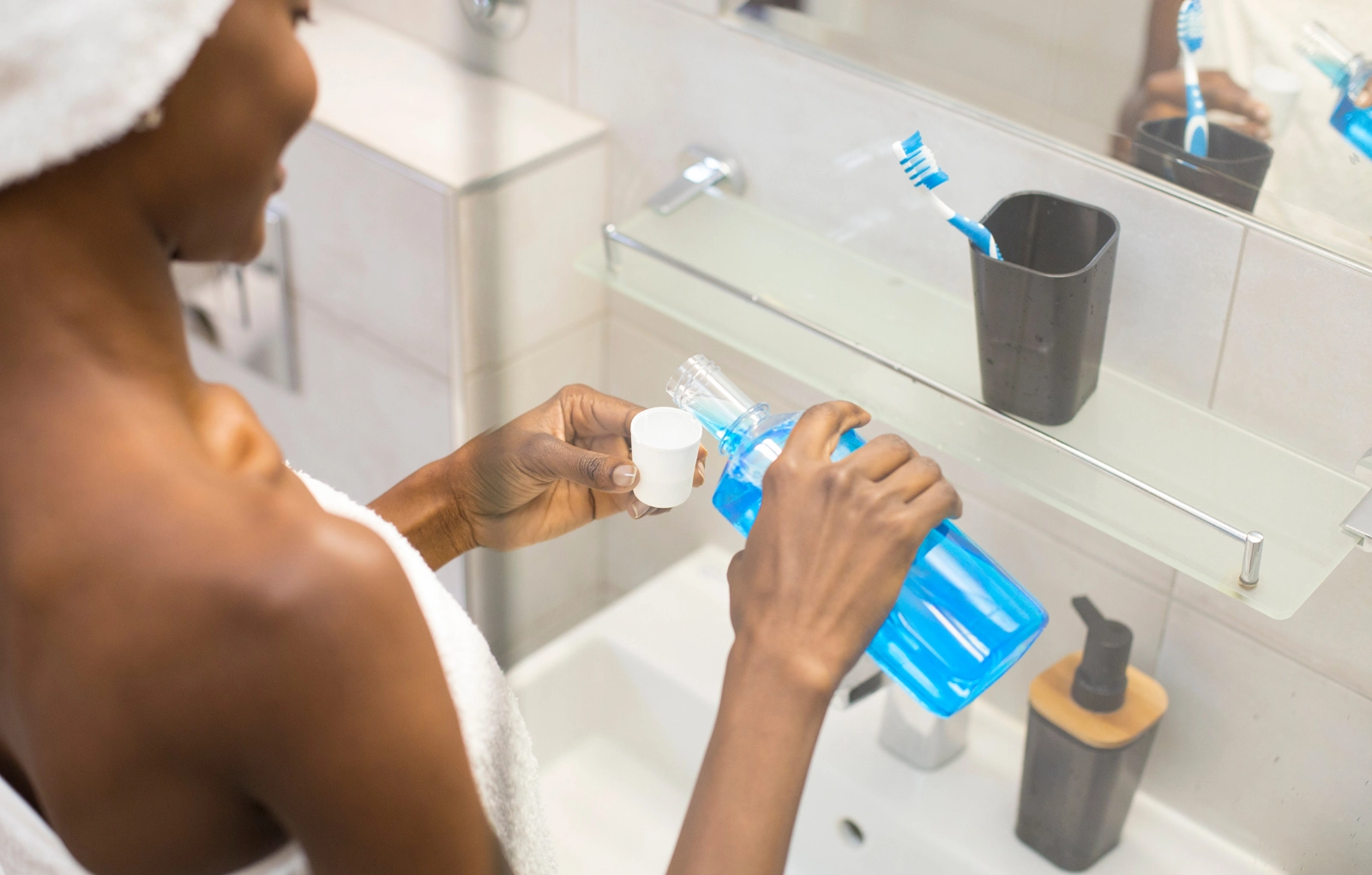
Most commercial mouthwashes kill good and bad bacteria alike — which can actually make gum disease worse over time, not better. Warm saltwater is genuinely the best daily rinse for most people. There are also some excellent natural alternatives worth knowing about. Here’s the honest breakdown.
There’s probably a bottle of Listerine in your bathroom right now. Maybe chlorhexidine if your dentist prescribed it. You’ve been using it because it makes your mouth feel clean and you were told it’s good for your gums.
I want to have an honest conversation about that.
Because for a lot of patients, that daily rinse — the one they’ve been faithfully using for years — is quietly working against them.
YOUR MOUTH IS SUPPOSED TO HAVE BACTERIA IN IT
I know that sounds wrong. We’ve spent decades being told that bacteria in the mouth equals bad, and that the goal is to kill as many of them as possible.
But your mouth is home to over 700 different species of bacteria. The vast majority of them are not just harmless — they’re actively working for you. They compete with the bad bacteria for space. They help maintain the right pH balance so your enamel stays strong. They communicate with your immune system. They’re part of an ecosystem that took millions of years to develop.
When you rinse with an antiseptic mouthwash every day, it doesn’t know the difference between the good guys and the bad guys. It kills everything. Every single day.
Here’s the part that should give you pause: when you wipe out the beneficial bacteria alongside the harmful ones, you create an opening. The harmful strains — the ones that cause gum disease and decay — are often faster to repopulate. So you end up with a mouth that’s repeatedly being stripped of its natural defenses, which the problematic bacteria are happy to exploit.
Research has confirmed this: the disruption caused by long-term antiseptic use can actually precede the establishment of gum disease. The very thing you’re using to protect your gums may be contributing to the problem you’re trying to prevent.
Think of it like taking a low-dose antibiotic every single day. You wouldn’t do that for your gut. Your mouth deserves the same logic.
THE PRESCRIPTION RINSE THAT RAISES YOUR BLOOD PRESSURE — AND WHO IT’S HURTING MOST
Many patients with gum disease get prescribed chlorhexidine rinse — a stronger antiseptic, usually used after surgery or during a flare-up. Short term, for specific situations, it has its place.
But here’s something most patients are never told: research has found that long-term use of chlorhexidine disrupts your body’s ability to produce nitric oxide — a molecule your blood vessels need to relax and function properly. The result? Raised blood pressure, strain on the heart, effects on vascular health.
Now here’s where this gets really important — and honestly, where I think the dental profession needs to do better.
Gum disease and heart disease are deeply connected. We’ve known for years that the same bacteria that cause chronic gum disease have been found in cardiovascular plaques, in arterial walls, in the tissue surrounding the heart. People with untreated gum disease have significantly higher rates of heart attack and stroke. The two conditions feed each other.
So think about who is most commonly prescribed long-term chlorhexidine rinse: patients with serious gum disease. And who are patients with serious gum disease most likely to be? Patients who already have cardiovascular concerns — high blood pressure, heart disease, or a history of cardiac events.
We are giving the patients who are most vulnerable to cardiovascular damage a rinse that research shows raises blood pressure and strains the heart. The very people who can least afford it.
I’m not saying every dentist who prescribes chlorhexidine is doing something wrong. Most are simply following protocols that were developed before this research existed. But this is exactly why staying current with the science matters — and why patients deserve to be part of the conversation about what’s going into their body and what the downstream effects might be.
Chlorhexidine has its place. Used short-term, for a specific purpose, it’s a legitimate tool. Used daily for months or years without question? That’s a conversation worth having with your dentist.
WHAT WE ACTUALLY RECOMMEND
Warm saltwater — and we mean it
This is not a consolation prize for people who can’t have “real” mouthwash. Saltwater is genuinely excellent for your mouth and has been for thousands of years.
Here’s why it works so well: salt draws excess fluid out of inflamed tissue, which reduces swelling and soreness. It lowers the acidity in your mouth, making it less hospitable to the bacteria that cause decay and gum disease. It supports the natural repair process — specifically by helping the cells responsible for healing your gum tissue migrate to where they’re needed. And it does all of this without disrupting the balance of your oral microbiome.
It costs about three cents a day. It doesn’t burn. It doesn’t stain your teeth. It doesn’t raise your blood pressure.
Half a teaspoon of sea salt in a cup of warm water. That’s the recommendation we give almost every patient.
StellaLife VEGA — for post-surgical healing and sensitive mouths
In our office, every patient who has had a procedure gets StellaLife VEGA rinse instead of chlorhexidine. And without fail, they describe the same thing: it feels like putting aloe on a burn. Immediately soothing. No harshness, no burning.
That’s not a coincidence. A head-to-head clinical study compared StellaLife directly to chlorhexidine on the cells responsible for healing gum tissue. Even a tiny fraction of standard chlorhexidine concentration killed those cells outright. StellaLife, by contrast, actually stimulated those cells to migrate, multiply, and produce the collagen needed to heal — while chlorhexidine was shown to reduce collagen production by 50%.
In other words: chlorhexidine is killing the very cells trying to heal your mouth. StellaLife is activating them. That’s why our post-op patients heal so well and feel so much better than they expected.
StellaLife’s active ingredients are botanical — neem, calendula, echinacea, and plantain — with supporting ingredients including propolis and xylitol. Nothing harsh. Nothing that disrupts your microbiome.
For dry mouth: Biotene
If you struggle with dry mouth — which can be caused by medications, mouth breathing, or certain health conditions — regular rinses won’t address it and many will make it worse because of their alcohol content. Biotene is specifically formulated for dry mouth, it’s alcohol-free, and it manages the symptoms well.
For the health-conscious patient: probiotic and xylitol rinses
Probiotic rinses introduce beneficial bacterial strains directly into your mouth — seeding the environment with good bacteria rather than trying to eliminate everything. A clinical trial found probiotic mouthwash was comparable to chlorhexidine in reducing plaque and gum inflammation over 12 weeks, without the side effects. Brands like ProBiora and PerioSciences are worth exploring.
Xylitol-based rinses work differently — xylitol disrupts the metabolism of cavity-causing bacteria and their ability to stick to your teeth. Spry makes a well-regarded xylitol rinse that’s alcohol-free and fluoride-free.
WHAT ABOUT OIL PULLING?
Oil pulling — swishing a tablespoon of coconut or sesame oil — is an ancient practice with genuine research behind it. But here’s the catch most articles leave out: to get the actual benefit, you need to swish for 15 to 20 minutes. Not a quick rinse. Twenty full minutes.
That’s where most people fall off. Done consistently, it can be a meaningful addition to your routine. But a two-minute oil pull before you run out the door isn’t really oil pulling. It’s just getting oil in your mouth.
Technique matters: a tablespoon of oil, gentle swishing for 15-20 minutes, spit into the trash (not the sink — it solidifies in pipes), rinse with warm saltwater, then brush.
THE SIMPLE VERSION
Your mouth isn’t a surface to be sterilized. It’s a living ecosystem. The goal is balance — supporting the beneficial bacteria, keeping the harmful ones in check, and not burning the whole house down because one room needs tidying.
For most people, warm saltwater every day does that job beautifully. Add a quality natural rinse if you want more support. Skip the daily antiseptic. And if you’ve been told to use chlorhexidine long-term, it’s worth having a conversation about whether that’s actually serving you.
To schedule at Supremia Dentistry in Wake Forest, call 919-556-6200 or request an appointment online.
Dr. Morgan Herman, DDS, is a holistic, airway-focused dentist and TMD specialist at Supremia Dentistry in Wake Forest, NC. She is a Diplomate of the American Academy of Dental Sleep Medicine, a Fellow of the Las Vegas Institute for Advanced Dental Studies and the International Academy of Dental Facial Esthetics, and a member of the International Academy of Oral Medicine and Toxicology (IAOMT).